

African swine fever virus is a highly contagious virus that causes a deadly disease in domestic pigs and wild boars, with mortality that can reach almost 100% in severe outbreaks. It does not infect humans, but it causes huge economic losses for farmers, affects pork prices, and threatens food security in many countries.
The disease has spread from Africa to Europe, Asia, and other regions over the past decades, making it a major global animal health concern. As one scientific review notes, African swine fever “remains one of the most formidable threats to global swine health” because of its complex nature and lack of widely available vaccines.
Have you ever wondered:
• What exactly is this virus?
• How do African swine fever symptoms look in real farms?
• What is the African swine fever mode of transmission?
• Is there any African swine fever treatment or vaccine?
What is African swine fever virus?
African swine fever virus (ASFV) is a large, double stranded DNA virus that belongs to the family Asfarviridae. It mainly infects cells of the immune system, particularly monocytes and macrophages, leading to severe inflammation, damage to blood vessels, and organ failure in pigs.
The virus is very tough in the environment and can survive for long periods in pork, blood, and even contaminated equipment or clothing. Because of this hardiness, once it enters a farm or region, it is difficult to eliminate without strict biosecurity and culling measures.
A 2025 review highlights that at least 23 genotypes of ASFV have been identified, which complicates diagnosis and vaccine development. This diversity is one reason why a simple “one vaccine for all” approach has not worked so far.
“ASFV primarily targets monocytes and macrophages, leading to severe lymphoid depletion, systemic inflammation, and vascular pathology,” notes a scientific review on the virus.
African Swine Fever Symptoms in Pigs
African swine fever symptoms can vary from sudden death with few signs to more gradual disease with fever and bleeding. The exact presentation depends on the virus strain and the pig’s immune status.
Early and general signs
Common early African swine fever symptoms include:
• High fever (about 40.5–42°C)
• Loss of appetite and refusal to eat
• Lethargy, weakness, and huddling together
• Rapid or laboured breathing
• Depression and reluctance to move
These signs usually appear 3–7 days after infection, though the incubation period can be up to 15 days in some natural cases.
Visible skin and bleeding signs
As the disease progresses, especially with highly virulent strains, more dramatic signs appear:
• Red or blue purple discolouration (cyanosis) of ears, snout, tail, and lower legs
• Red or purple spots on the skin, especially on ears and flanks
• Bleeding from nose or anus
• Vomiting and diarrhoea, sometimes with blood
In acute disease, many pigs may die within a few days after onset of fever, and some may die suddenly with almost no warning signs.
A field manual from FAO describes typical cases: “They huddle together, are very weak and have a high fever,” often with flushed skin in white skinned pigs. If you are a farmer or vet, any sudden high mortality with fever and bleeding signs in pigs should raise immediate suspicion of African swine fever.
African swine fever mode of transmission
Understanding the African swine fever mode of transmission is essential for control. The virus spreads through direct contact, contaminated materials, and certain tick species.
Main routes of spread between pigs
Key transmission routes include:
• Direct contact with infected pigs (saliva, blood, faeces, urine)
• Ingestion of contaminated pork products or swill feed containing infected meat
• Contact with contaminated equipment, vehicles, clothing, footwear, or tools (fomites)
• Bites from infected Ornithodoros soft ticks in regions where these vectors are present
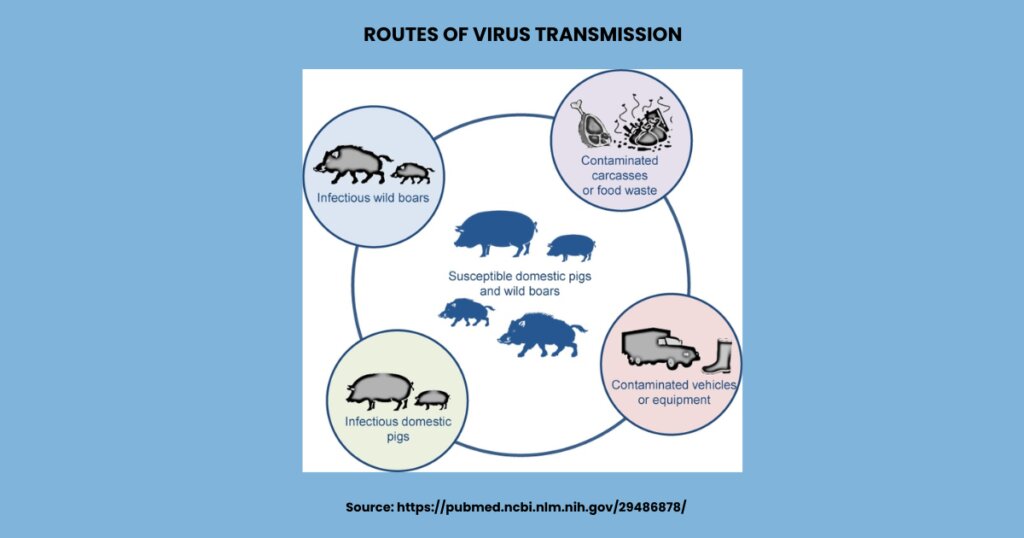
The primary entry route is usually the oral or nasal route, after which the virus first replicates in the tonsils and nearby lymph nodes and then spreads through the blood to the whole body.
Government agencies repeatedly warn that human mediated movement of pigs, pork products, and contaminated materials is one of the highest risk pathways for long distance spread.
According to the MSD Veterinary Manual, “the primary route of infection by ASFV is the upper respiratory tract,” with rapid spread via the bloodstream and virus present in many secretions and excretions.
Is there African swine fever treatment?
At present, there is no specific antiviral African swine fever treatment proven to cure infected pigs. Management mainly focuses on early detection, rapid reporting, culling of infected and exposed animals, and strict biosecurity.
Typical control steps recommended by authorities include:
• Immediate reporting of suspected cases to veterinary or animal husbandry departments
• Quarantine of affected farms and movement restrictions
• Humane culling and safe disposal of carcasses and contaminated materials
• Thorough cleaning and disinfection of facilities, vehicles, and equipment
• Strengthening farm biosecurity (controlled entry, dedicated clothing, no swill feeding, controlled visitors)
Supportive care for pigs (fluids, temperature control, secondary infection management) may be attempted in some experimental or small scale settings, but it does not eliminate the virus and is not a standard control method during outbreaks.
Guidance from national or state animal husbandry departments and the World Organisation for Animal Health (WOAH) should be followed in suspected cases. Many countries treat ASF as a notifiable disease with strict legal requirements.
African Swine Fever in Humans: Is It a Risk?
A common worry is whether African swine Fever in humans is a real possibility. Current evidence shows that ASFV does not infect people and is not considered a public health threat.
Regulatory agencies emphasise that:
• ASF affects only pigs (domestic and wild), not humans
• People cannot get sick from ASF by eating properly cooked pork
• The main risk from contaminated pork products is spread to other pigs, not infection in humans
However, human behaviour plays a major role in disease spread, because people move pigs, pork, and equipment across farms and borders. So, while African swine Fever in humans as a disease is not a concern, human responsibility in biosecurity is very important for control.
The U.S. FDA states clearly that ASF “does not pose a risk to human health” but is devastating for pigs and the pig industry.
African Swine Fever Vaccine: What Is the Update?
For decades, a safe and effective African swine fever vaccine was not available for field use, which made ASF very difficult to control. This is slowly changing, but the situation is still evolving and varies by country.
Research progress
Recent research has led to several promising vaccine candidates:
• Live attenuated vaccines (weakened forms of the virus) that protect pigs against certain ASFV strains
• Subunit vaccines targeting specific viral proteins, such as a CD2v based vaccine that showed “sterile immunity” (no detectable virus after challenge) in experimental pigs
• Synthetic genomics platforms that allow precise engineering of viral genes for rational vaccine design
A 2025 research round up reported a CD2v based subunit African swine fever vaccine that achieved complete protection in experimental trials, without using live virus. Another international study on a live attenuated vaccine candidate showed good protection against some strains but variable results against others.
Field use in some regions
Some countries have started limited or emergency use of ASF vaccines under regulatory oversight.
For example, a 2025 FAO update reported emergency use of an AVAC ASF live vaccine in certain Asian regions with imported doses for local pigs. However, these vaccines may not yet be widely available or licensed everywhere, and careful monitoring for safety and effectiveness is ongoing.
For farmers and veterinarians in India, it is advisable to follow updates from the Department of Animal Husbandry and Dairying, state veterinary universities, and WOAH for any regulatory approvals for ASF vaccines.
How Farmers and Veterinarians Can Reduce Risk?
Even as African swine fever vaccine research advances, prevention through biosecurity remains the primary tool. African swine fever treatment options are limited, so early action is key.
Some practical measures include:
• Keep a closed herd where possible; avoid bringing in pigs from unknown or high risk sources
• Quarantine new pigs before mixing with the main herd
• Do not feed swill or kitchen waste containing meat or meat products
• Use dedicated clothing, boots, and tools on the farm; clean and disinfect regularly
• Control visitors, transport vehicles, and equipment entering the farm
• Report sudden deaths, fever, or bleeding symptoms in pigs to a veterinarian or local animal husbandry officer immediately
For farmers, simple practices like handwashing, changing footwear, and avoiding sharing tools between farms can make a big difference.
On A Final Note…
African swine fever virus is a fast spreading, deadly threat to pigs that has reshaped the swine industry across continents.
While African swine fever treatment remains limited and vaccines are still under development and phased introduction, strong biosecurity, early reporting, and awareness of African swine fever symptoms and transmission are the most practical tools available today.
FAQs
1. What is African swine fever virus?
African swine fever virus is a contagious DNA virus that infects pigs and wild boars, causing a serious disease with high death rates and major economic losses. It does not infect humans.
2. What are the most common African swine fever symptoms?
Common African swine fever symptoms include high fever, loss of appetite, weakness, red or blue‑purple skin, vomiting or diarrhoea (often with blood), breathing difficulty, and sudden death in many pigs.
3. How does African swine fever spread from pig to pig?
The African swine fever mode of transmission includes direct contact with infected pigs, ingestion of contaminated pork or swill, exposure to contaminated equipment, clothing, or vehicles, and bites from infected soft ticks in certain regions.
4. Can humans get African swine fever?
No. Current evidence shows African swine Fever in humans does not occur; the virus does not infect people and is not considered a human health threat, though it is disastrous for pigs and pig farmers.
5. Is there any African swine fever treatment available?
There is no specific antiviral African swine fever treatment for pigs at present. Control relies on early detection, culling, quarantine, and strict farm biosecurity. Supportive care does not remove the virus.
