The central dogma of molecular biology is one of the most important ideas in modern biology. If you want to understand how your cells work, how genes express themselves, and how proteins are made, this concept gives the answer.
Many students often ask, “What is central dogma?” or “Why is it important in life sciences?” This article explains it in simple terms so anyone can understand.
Richard Feynman once said, “What I cannot create, I do not understand.” This applies perfectly to biology. To understand life, we must understand how cells create proteins, because proteins do almost every job inside the body. The central dogma of molecular biology explains exactly how this creation happens.
Let us explore this idea step by step. Shall we?
What Is Central Dogma of Molecular Biology?
To answer what is central dogma, we must look at the basic principle:
DNA makes RNA, and RNA makes protein.
Before we get deep into the topic, let us understand the core concept first – “what is central dogma.”
What is Central Dogma?
Central dogma is a basic principle in molecular biology that explains how genetic information flows inside a living cell. And in molecular biology, this concept describes the flow of genetic information in living organisms. No matter which organism you study, from bacteria to humans, this flow remains the same.
The term central dogma was proposed by Francis Crick in 1958. He explained that information flows in one direction and cannot go backwards under natural conditions. According to Crick, “Information cannot be transferred back from protein to either protein or nucleic acid.”
This statement became a strong foundation for molecular biology.
Why Do We Study the Central Dogma?
Ask yourself these questions:
- How do our cells know when to make insulin?
- Why do some traits pass from parents to children?
- How does a single cell develop into a complete human body?
All these questions can be answered using the central dogma of molecular biology. It helps us understand diseases, genetics, biotechnology, and even cancer research.
Central Dogma Steps in Order
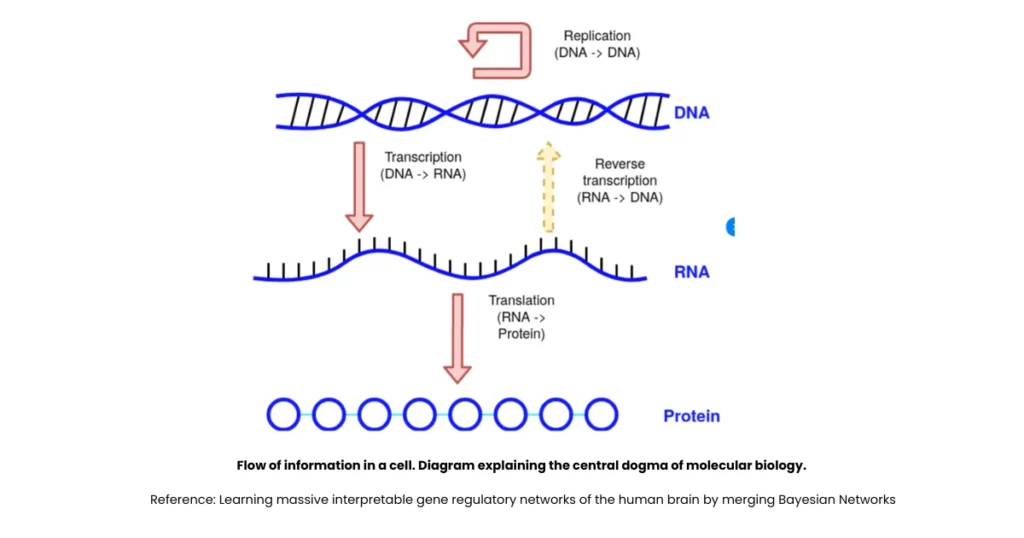
Many students search online for central dogma steps in order because they want a simple list. Here are the steps:
- Replication: DNA copies itself.
- Transcription: DNA information is transferred to RNA.
- Translation: RNA information is used to make proteins.
These central dogma steps in order form the base of all biological processes. Without them, life would not function.
Flow Chart of Central Dogma
Here is a simple flow chart representation that students often search for when they ask to give the flow chart of central dogma:
DNA – RNA – Protein
Replication – Transcription – Translation
This flow chart shows how information moves inside the cell. It also supports the definition of what is central dogma and helps in understanding exam questions.
Replication: The First Step
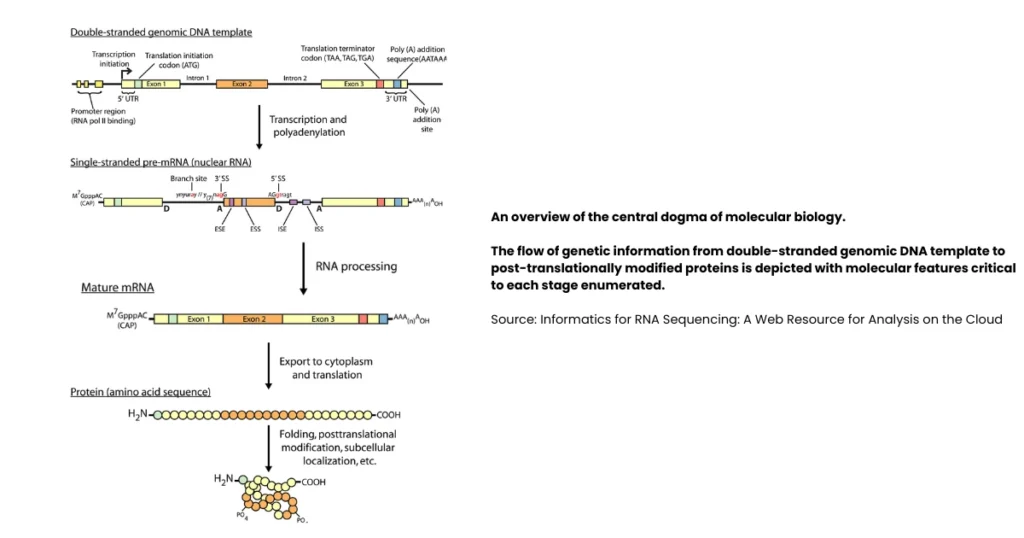
Replication means DNA makes more DNA. When cells divide, both new cells need the same set of genetic information. DNA polymerase reads the DNA strand and adds complementary bases to form the new strand. This is supported by decades of biochemical experiments.
Transcription: Making RNA from DNA
Transcription is the second step of the central dogma of molecular biology. Here, a small part of DNA is copied into RNA.
Key points:
- The enzyme RNA polymerase performs transcription.
- Only selected genes are transcribed at a time.
- The product is mRNA (messenger RNA).
Francis Crick described transcription as the “reading and writing system of the cell.”
Read More: Why Do Patients Pay Even After Insurance? Deductible in Medical Billing
Translation: Making Proteins from RNA
Translation is the final step. Ribosomes read the mRNA sequence and convert it into a protein.
In 1961, François Jacob and Jacques Monod experimentally proved that mRNA carries instructions from DNA to ribosomes.
This discovery strengthened the model of the central dogma of molecular biology. Proteins formed through translation act as enzymes, hormones, structural support, and much more. Life depends on continuous translation.
Why Is the Central Dogma Important Today?
Even today, scientists rely on this concept to understand:
- Genetic engineering
- mRNA vaccines
- Cancer mutations
- Drug discovery
- Gene therapy
1. Genetic Engineering
The central dogma helps scientists understand how genes control traits and how proteins are produced. When scientists change or insert a gene inside an organism (for example, in crops or bacteria), they rely on the central dogma to predict how that modified gene will be transcribed into RNA and translated into a protein. Without this knowledge, modern genetic engineering would not be possible.
2. mRNA Vaccines
mRNA vaccines, like the COVID-19 vaccines, use the same logic as the central dogma.
The vaccine gives the body a small piece of mRNA. This mRNA enters the cell and is translated into a harmless protein, which trains the immune system.
3. Cancer Mutations
Cancer often begins when DNA gets damaged or mutated. Since the central dogma explains how DNA instructions are converted into proteins, it helps scientists understand how a mutation leads to faulty proteins.
These faulty proteins may cause uncontrolled cell growth. By studying the central dogma, researchers learn how mutations change cell behaviour and how to design targeted treatments.
4. Drug Discovery
Most medicines work by interacting with proteins in the body. The central dogma helps identify which proteins are responsible for a disease. Once these proteins are known, drug developers can design medicines that block, activate, or correct them.
Modern drug design depends heavily on understanding how a gene produces a specific protein.
5. Gene Therapy
Gene therapy tries to fix faulty genes so the body can make normal, healthy proteins again. This is directly based on the central dogma. If the correct DNA is delivered to the cell, it will be transcribed into RNA and translated into the right protein. Many genetic disorders are now being treated using this method.
Every innovation in biotechnology traces back to the central dogma of molecular biology.
On A Final Note…
The central dogma of molecular biology remains one of the strongest foundations in life sciences. By understanding what is central dogma, students can understand how information flows in the body, how proteins are made, and how diseases occur. When we give the flow chart of central dogma and list the central dogma steps in order, the concept becomes simple and clear.
If you are preparing for exams, interviews, or biotechnology careers, this model will stay with you throughout your journey.
FAQs
What is central dogma in simple words?
It is the concept that DNA makes RNA, and RNA makes protein. It describes how genetic information flows inside the cell.
Who proposed the central dogma of molecular biology?
The central dogma was proposed by Francis Crick in 1958.
What are the central dogma steps in order?
Replication, transcription, and translation.
Can protein convert back to DNA?
According to Crick’s statement, information does not flow backward from protein to DNA.
What is the flow chart of the central dogma?
DNA → RNA → Protein.
Replication → Transcription → Translation.
